
Featured Articles


Blog title heading will go here

Blog title heading will go here

Blog title heading will go here
Take Five. A series in which I empty my pockets and set out the things I keep going back to – magazines, hotels, books, restaurants, furniture and lighting brands – and try to say honestly why. It is not a ranking, and nothing in it is sponsored. Think of it less as a list of recommendations than as being handed the pile from beside my desk.
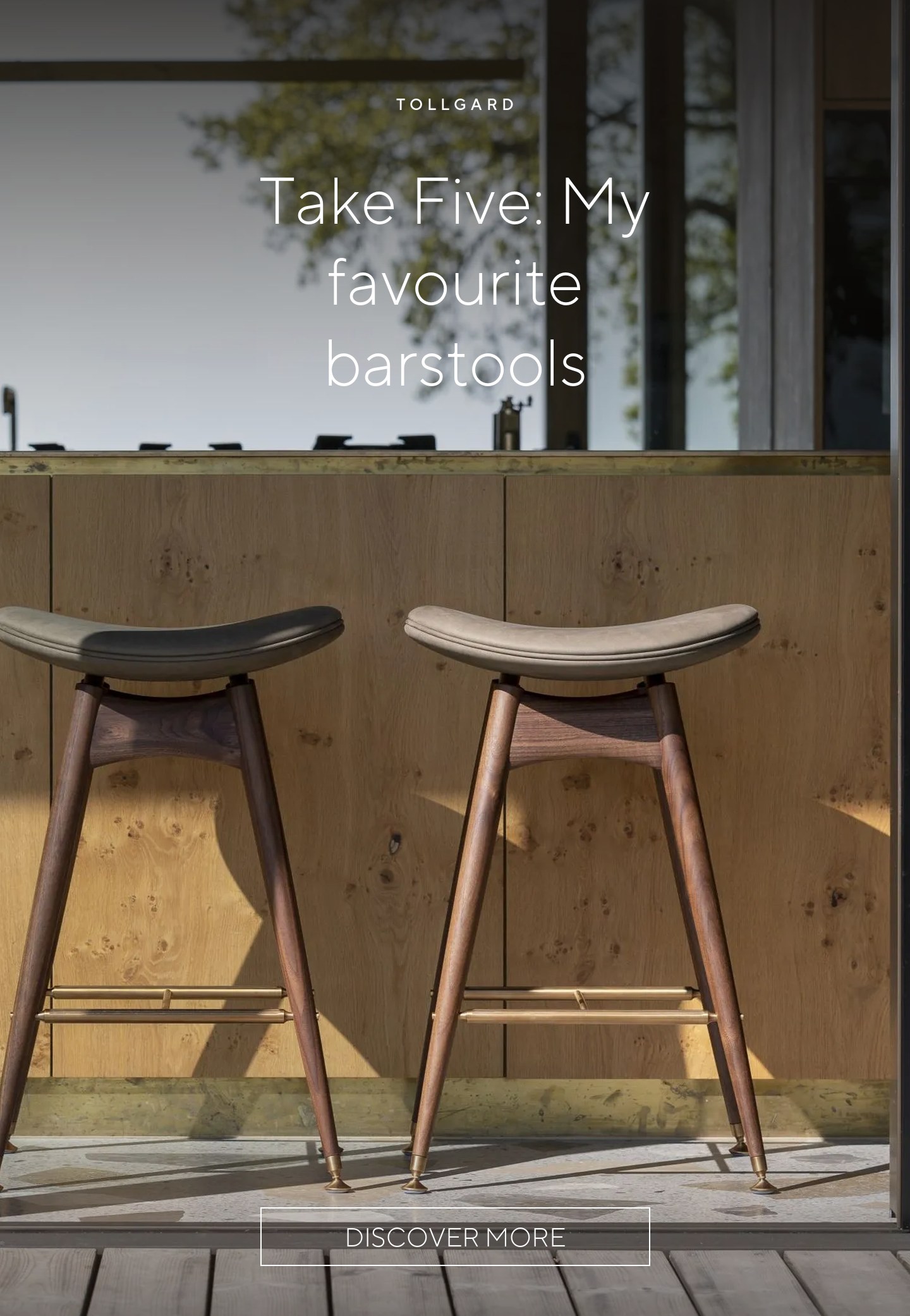
This time, the barstool. It is the hardest-working chair in most of the homes we design, and very often the least considered. It gets chosen last, after the stone and the taps, and bought by the half-dozen to fill the length of an island.
That is a mistake, because the island has moved to the middle of the room. The kitchen is now where a family eats breakfast, does homework, pours a drink and keeps the cook company, and the stools are where all of that happens. They are seen from every side, including from behind, which is the side most chairs are allowed to hide. And they are sat on for two minutes or for two hours, by a child kicking their heels or a guest in good shoes.
Environmental psychologist Lily Bernheimer argues that human evolution proves that we need refuge as well as prospect. We need somewhere to feel safe and secure, and we need a view before us – as much for its beauty as for its warning that something might be coming to eat us. Open-plan living is prospect at its purest.
A stool at an island is prospect in its plainest form: a perch with a view of the whole room. The good ones add a little refuge back – a seat that holds you, a footrest at the right height, something to lean on. These five do.
A declaration before we begin: we work with all five makers, and all five stools are on display in our London showrooms now. Read what follows knowing it. As with the Danish brands and the solid-wood makers, the order runs the other way round from the one you might suspect: we went looking for these pieces because of how they sit, and we stock them for the same reason.
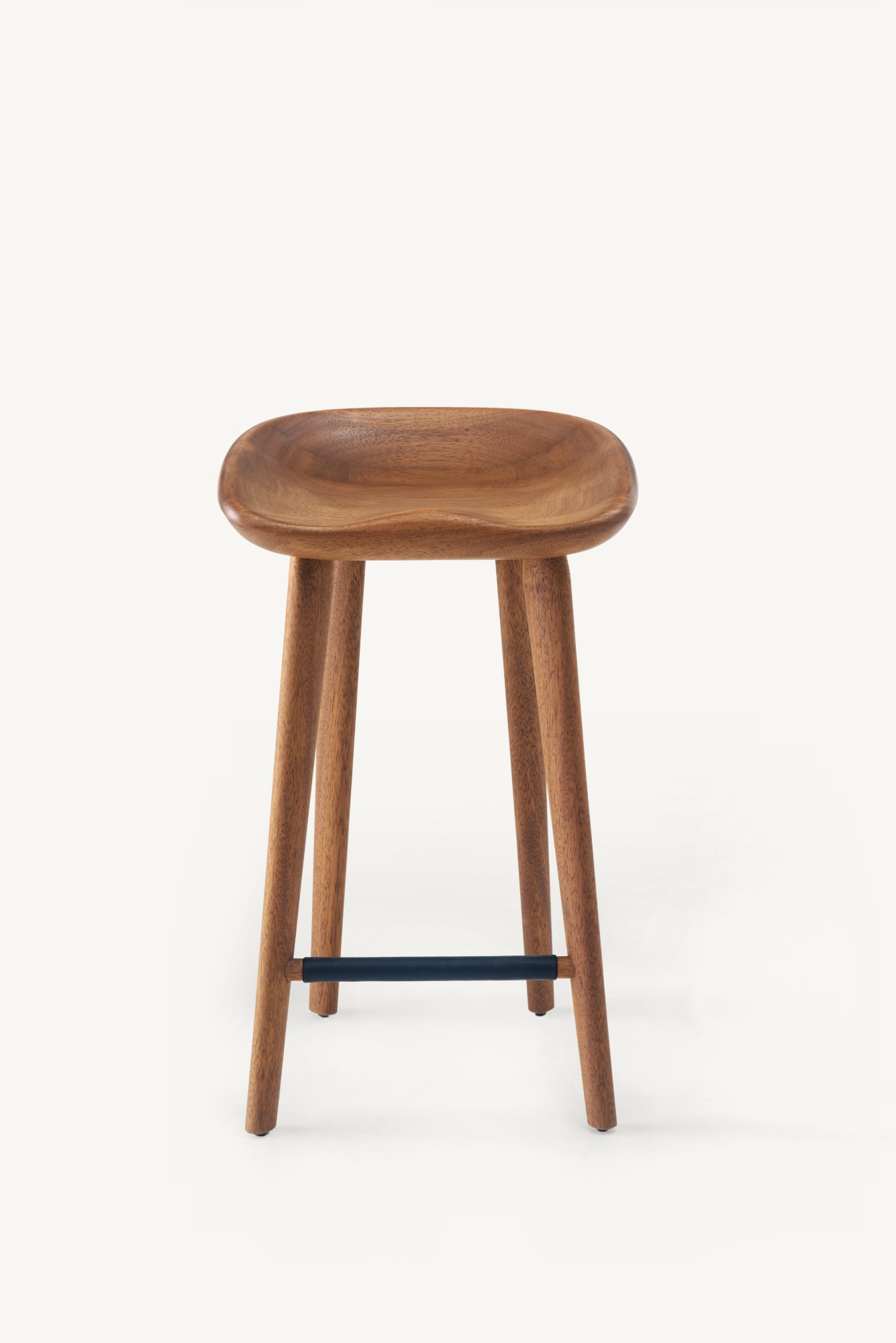
Tractor Stool – BassamFellows
The one that started at the side of a road. The story goes that Craig Bassam, an architect working on a project in Switzerland, came across an old tractor seat and was struck by how well it held him upright without any need for a back. He set out to make the same thing in wood. The stool he drew became, in effect, BassamFellows’ calling card when the studio he founded with Scott Fellows showed it at the Salone del Mobile in Milan in 2003.
It is still the purest idea on this list. There is no back and no upholstery, just a dished seat carved from a single block of solid timber – walnut, oak or ash – shaped by a precision carver and then finished by hand by cabinetmakers in Italy. It comes in three heights, the tallest with a seat at 77 centimetres. The studio calls its approach Craftsman Modern, and the Tractor is the clearest proof of it: a workman’s seat made with a cabinetmaker’s care. It also does something few stools manage, which is to look as good tucked under a counter as it does pulled out.
Circle Bar Stool – Overgaard & Dyrman
The one with the Danish line. Jasper Overgaard and Christian Dyrman met at Aalborg University in 2005, graduated together from the Royal Danish Academy in 2011 and founded Overgaard & Dyrman at the start of 2013. Their backgrounds explain a great deal. Christian trained as a blacksmith before he studied design; Jasper had explored leatherwork. Their first collection, Wire, married saddlery and precision metalwork, and they have made their own pieces in a workshop in northern Denmark since 2015.
The Circle Collection followed in 2019, and the bar stool is its second piece. The brief they set themselves was the circle itself, a shape they trace from Euclid to Leonardo to Wegner, and the stool is all arcs and soft curves: a fully upholstered seat in fabric or leather on a base of solid wood – oak, smoked oak, ash or walnut – with fittings and footrest in raw or aged brass or stainless steel. CNC machining sits alongside traditional joinery and classic upholstery, and each stool is made to order and individually numbered. In the Danish brands piece I described a line running from Finn Juhl to the studios still working that seam today. This is what I meant.
Limantour Stool – Luteca
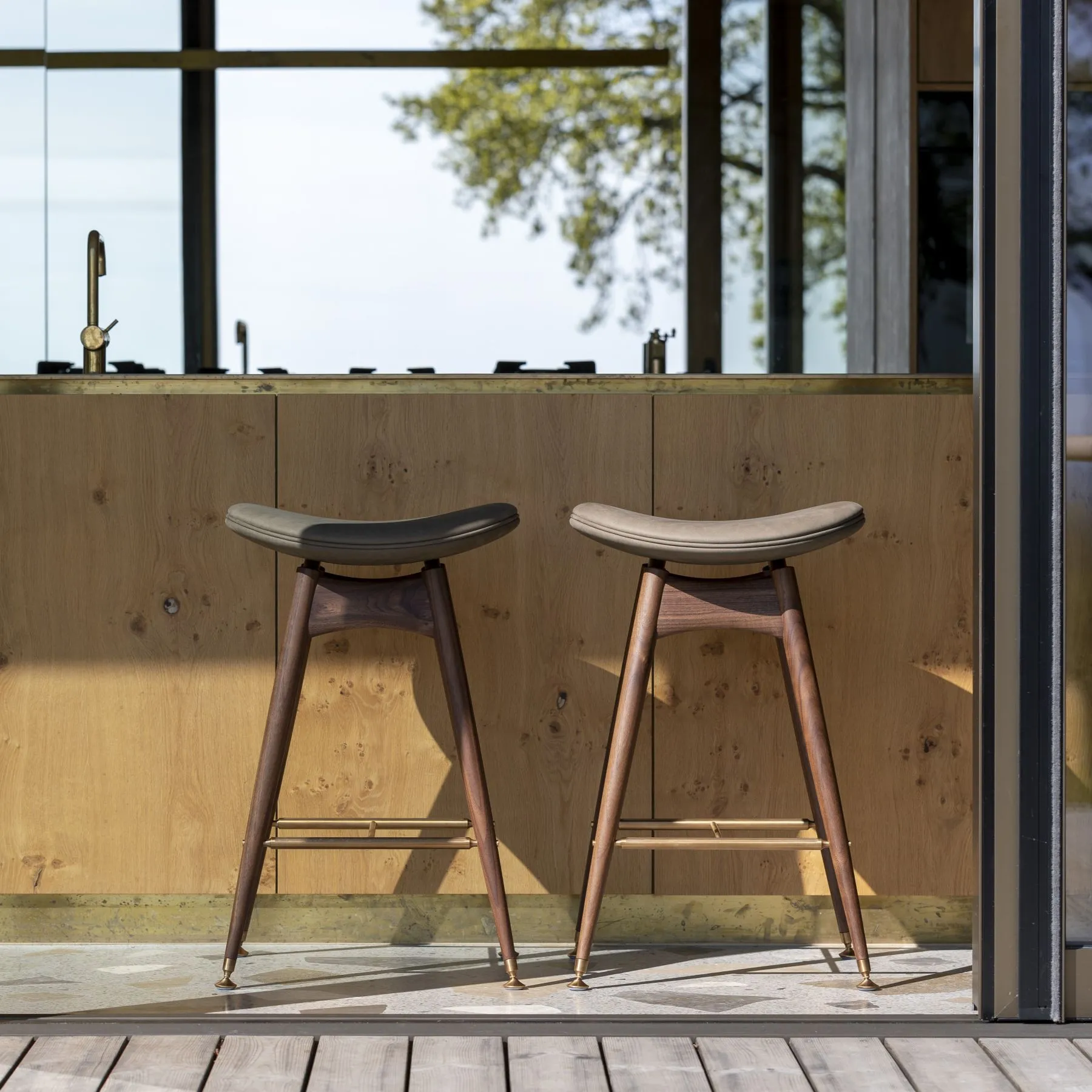
The one with a back, and a history it is honest about. Luteca was co-founded by Amanda Réant, its artistic director, and is now headquartered in France with production mainly in Mexico. Its in-house collection draws on twentieth-century Mexican designers who were overlooked in their time, Eugenio Escudero above all, and on the hand-making traditions that grew up around them.
The Limantour belongs to that lineage. It is a Mexican mid-century form: a frame of solid hardwood – walnut, oak or black ash – an upholstered seat, and a back that supports rather than merely suggests. That back matters more than it sounds. The stool you sit on for the whole of a long Sunday breakfast is not the stool you perch on for an espresso, and a kitchen used by a family needs both. The Limantour is the one I would put at the end of the island nearest the window, for whoever is staying longest. It is offered at bar or counter height.

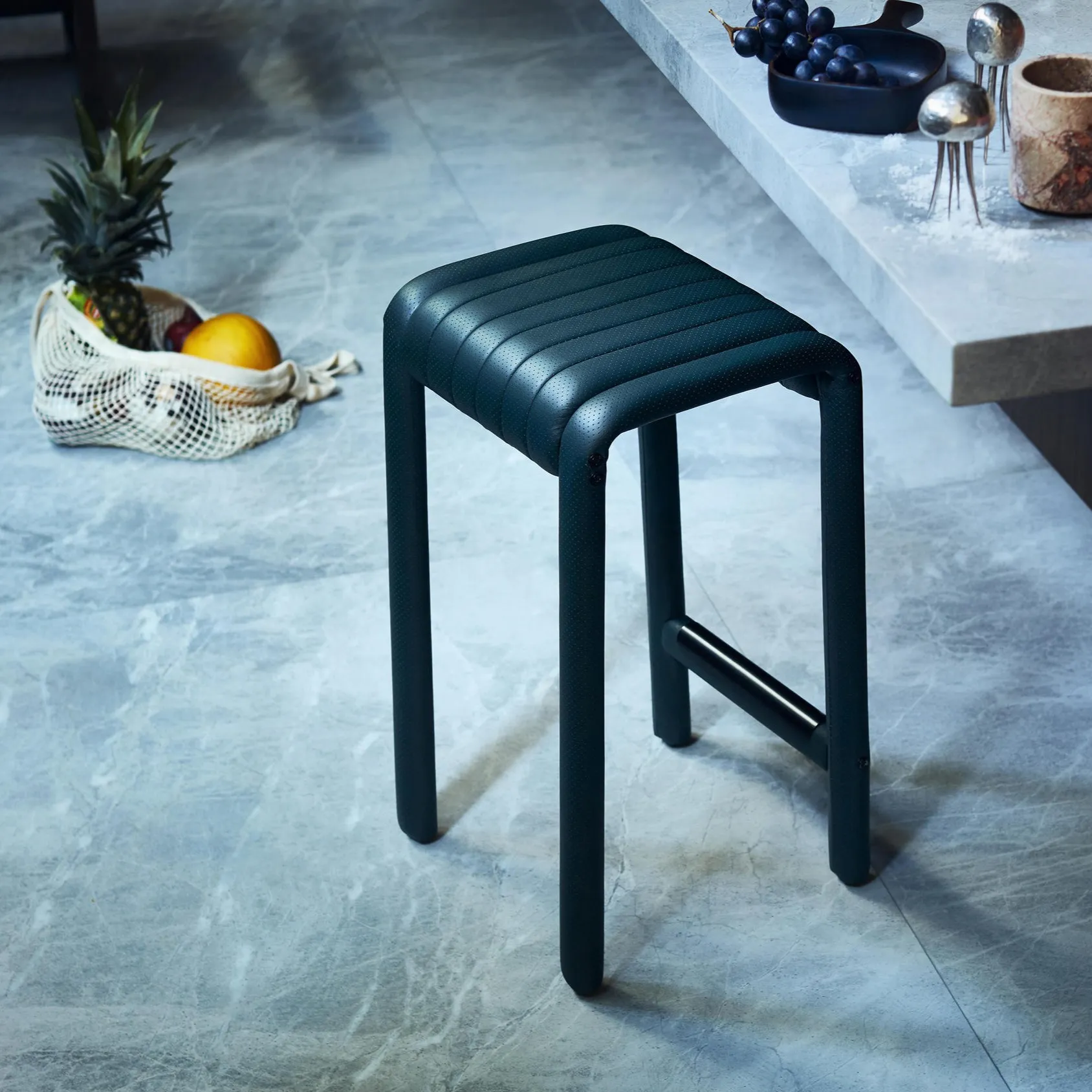
Alexander Street Stool – Philippe Malouin for Man of Parts
The one with a memory of the road. Man of Parts was founded in 2019 by Stephan Weishaupt, a co-founder of the design store Avenue Road, as a collection for a way of living rather than a single look. He works with a small group of designers he has known for years, the Canadian Philippe Malouin among them.
Malouin named this stool after the street in Montreal where he grew up, surrounded by the leather seats of twentieth-century sports cars, and you can see them in it: the ribs, the lines, the perforated leather wrapped over the form. The Alexander Street seating was reportedly the most difficult piece in the launch collection to make, and that shows too, in the best way. It is a counter stool, with its seat at 65 centimetres, and it is the most tailored thing on this list. Where the Tractor began in a farmyard, this one began in a driver’s seat, which seems about right for a stool that spends its life at the edge of the busiest room in the house.
Gentle Barstool – Sebastian Herkner for Linteloo
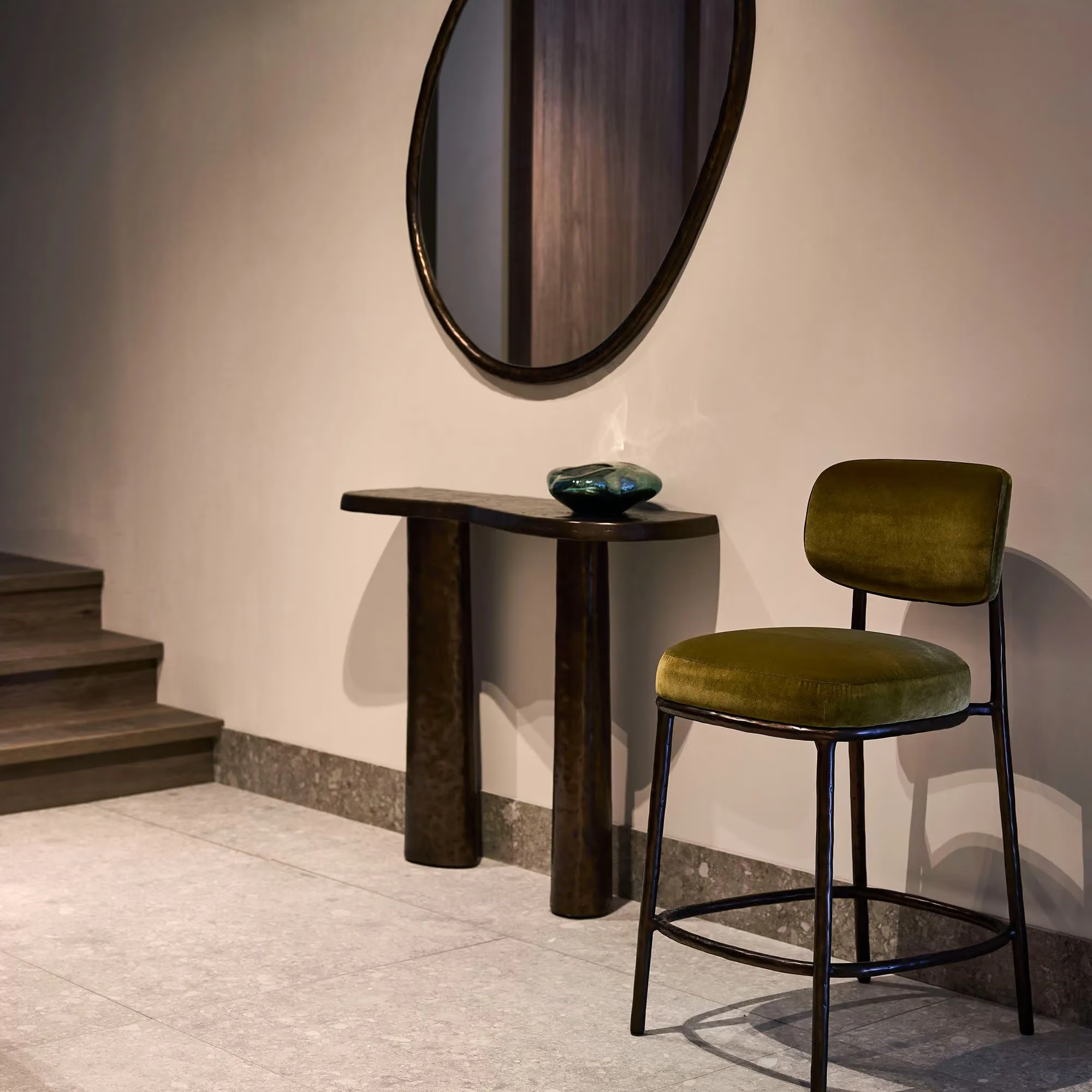
The one where you can see the maker’s hand. Sebastian Herkner, born in 1981, studied product design in Offenbach, interned with Stella McCartney in London and opened his own studio in 2006. Maison&Objet named him its Designer of the Year in 2019. He also works with Man of Parts, so this is not the first time his name has turned up beside Malouin’s.
Gentle is a family – dining chair, armchair and stool – made for the Dutch house of Linteloo, and the frame is where the story is. For each element, craftsmen model the mould by hand in clay, and aluminium is then cast into it, so the shaping of the person who made the mould survives in the finished metal. It is finished in bronze, and the seat is upholstered in fabric or leather. Cast aluminium usually reads as an industrial material. Here it reads as something sculpted, which is exactly what it is.
What the five have in common
A tractor seat, a circle, a Mexican modernist, a sports car and a clay mould. On paper they share almost nothing – carved timber, brass and leather, hardwood and upholstery, perforated hide, cast bronze-finished aluminium. What they share is that each puts the machine and the hand to work together. The Tractor is cut by a carver and finished by a cabinetmaker. The Circle is machined and then joined. The Gentle is cast, but from a mould somebody shaped. That combination is why all five can be made to a consistent standard and still feel as though a person was involved.
They also pass the test that matters most for a barstool, which is how they behave when nobody is sitting on them. A row of stools at an island is the first thing many people see when they walk into a kitchen. They have to hold the room when they are empty, and then be comfortable enough to keep someone talking long after the plates are cleared.
Our ambition is to improve our clients’ quality of life through good design. This means that each room or space needs a defined function and a reason to exist. The same goes for every chair in it, and perhaps the barstool most of all. Choose it early, sit on it before you buy it, and buy fewer, better ones. Think twice, buy once.
Take Five. A series in which I empty my pockets and set out the things I keep going back to — magazines, hotels, books, restaurants, furniture and lighting brands — and try to say honestly why. It is not a ranking, and nothing in it is sponsored. Think of it less as a list of recommendations than as being handed the pile from beside my desk.
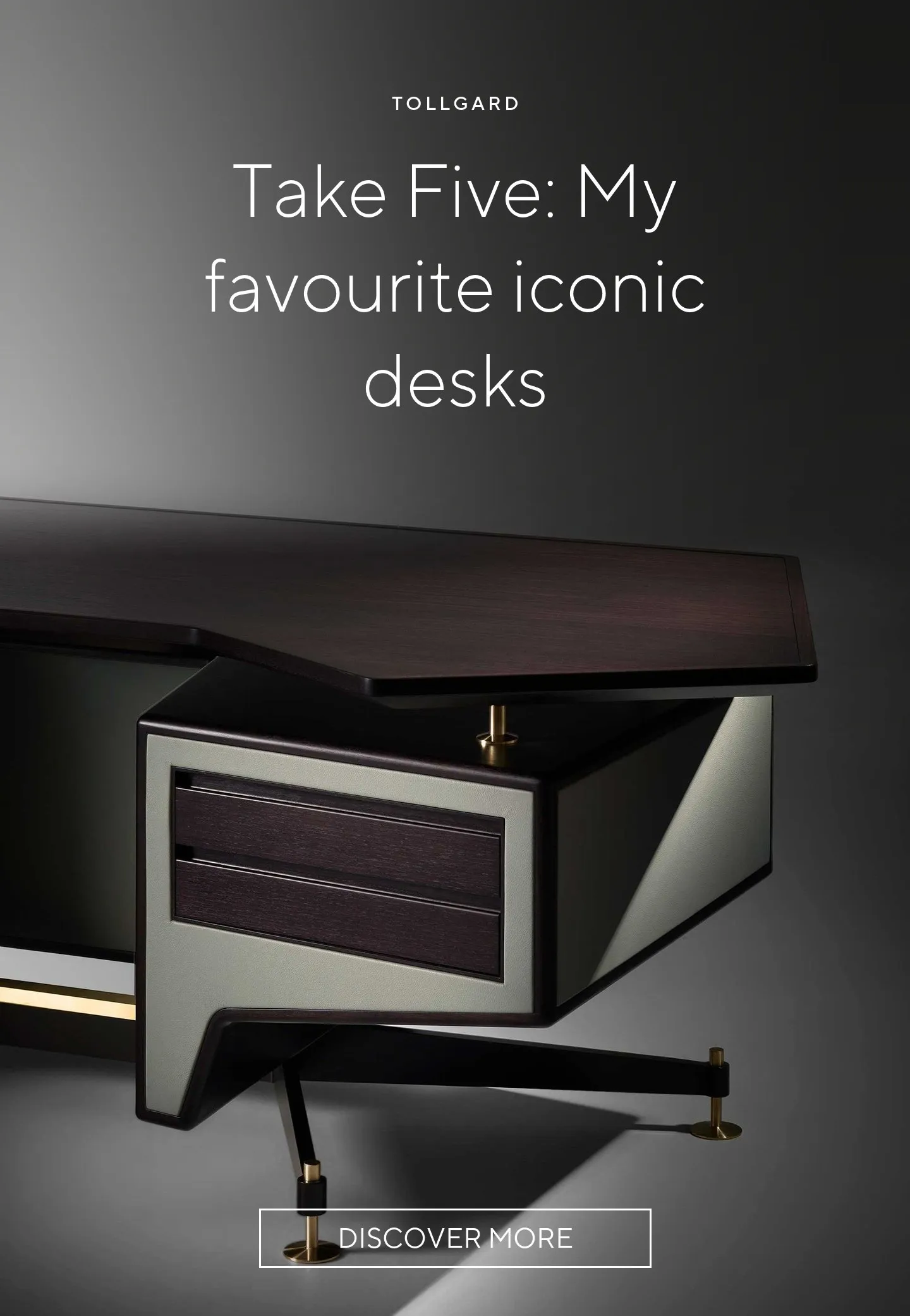
This time, the desk itself. I have spent more of my working life at a desk than at any other piece of furniture, and I suspect most readers have too. Yet it is so often the last thing chosen and the first thing compromised: pushed into a spare room, set against a wall, facing nothing.
It has also moved house. The desk used to belong to the office. Now, for many of the families we work with, it has to live in the home, where it is seen at the weekend as much as during the week. Before we draw anything, we map how a family uses each room. We use a technique we call heat-mapping to try and work out when there are too many functions crammed into one area of the house. If too many functions overlap, we call that area of the home overheated, or red.
The desk is very often what turns a room red. Which is why it has to be good to look at when nobody is working at it, and why these five earn their places.
A declaration before we begin: we represent all five of these makers, and you should read what follows knowing it. The closest interest is the 604, made by Ceccotti Collezioni, whose London showroom we run. I have put the five in the order they were drawn, from the 1950s to the last decade. Read in sequence, they tell a short story about what we have wanted from a place to work.
604 Desk — Mario Gottardi for Ceccotti Collezioni
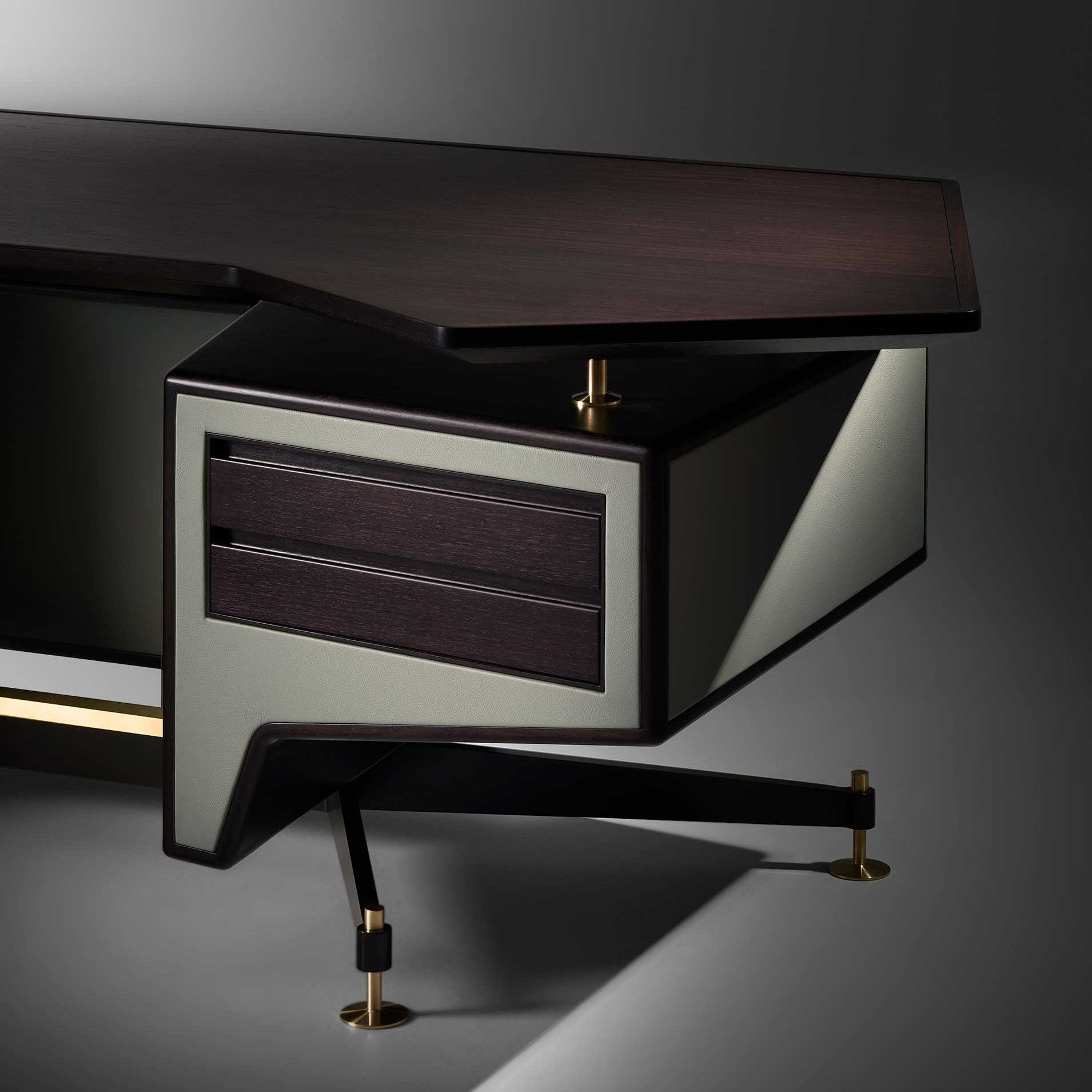
The captain’s desk. Mario Gottardi was a Venetian architect who made his name at sea: between 1953 and 1966 he won the competitions to design the interiors of four Italian liners, the Cristoforo Colombo, the Leonardo da Vinci, the Raffaello and the Michelangelo. A sketch dated 1954 shows the 604 drawn for the captain’s cabin of the Leonardo da Vinci, and it was built two years later for a company in Verona. You can still see the ship in it. Furniture at sea has to be handsome and it has to stay put, and the 604 is both.
Ceccotti makes it today in Cascina, outside Pisa, where Aviero Ceccotti opened his workshop in 1956. A central body of four leather-covered drawers is framed in solid American walnut and set on a metal base in a bronze finish, with brass footrests. Small brass spacers hold the top just clear of the body, so it seems to hover. At 255 centimetres long it is not a desk for a box room. It is a desk for someone who intends to stay at it for decades, which is rather the point. With a new culture of sustainability slowly moving through all creative industries, the idea of looking hard for an heirloom piece that passes down through generations holds a lot of value. We look hard and buy once.
Office Desk — Bodil Kjær for Karakter
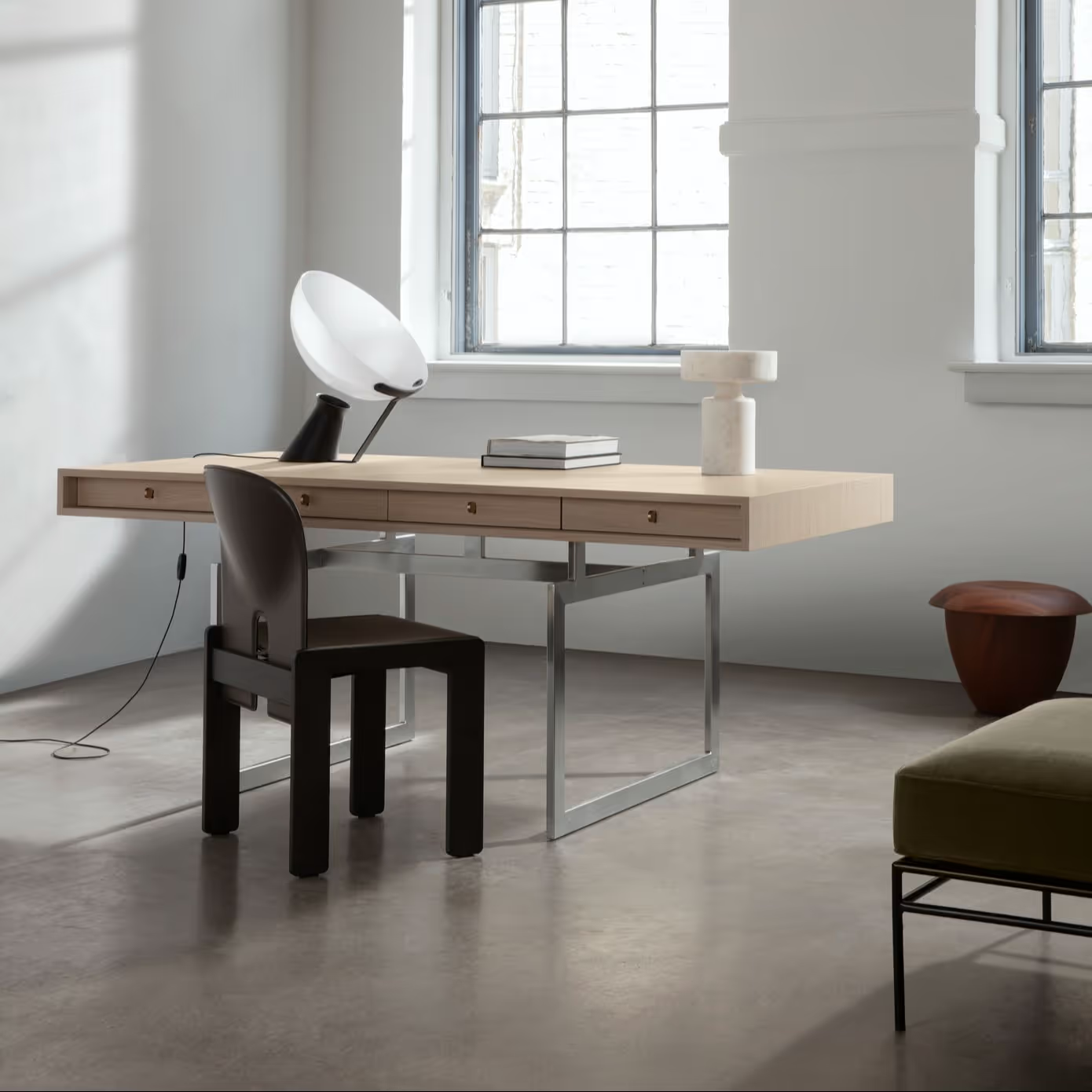
The one that floats. Bodil Kjær, born in 1932 and taught by Finn Juhl, drew it in 1959, and it was first made by E. Pedersen & Søn. She looked to Charles and Ray Eames rather than to her Danish contemporaries, and it shows. A thin steel frame carries a slim top with four drawers tucked beneath it, and the top appears to hover above the frame rather than rest on it. It has been called the most beautiful desk in the world, and also the James Bond desk. It earned the second name honestly, turning up in several of the early films, From Russia with Love among them, usually with a villain sitting behind it.
I have often wondered why the villains got it. I think it is because it is the desk of someone in complete control: nothing on show, nothing out of place. It makes the person sitting at it look composed, which is a great deal to ask of a piece of furniture. Karakter makes it today in oak or walnut, on a frame of powder-coated or brushed stainless steel, and it is the desk I would choose for a room that has to be a study by day and something calmer by night.
CH110 Desk — Hans J. Wegner for Carl Hansen & Søn

The unexpected Wegner. We think of Wegner as the master of solid wood — the Wishbone Chair, joints you want to run a thumb along. The CH110 of 1970 is something else. It was part of an office range, and its top, rails and two slim drawers are formed as one veneered unit and set on two flat stainless-steel legs. It is almost severe.
Then you open a drawer. The drawers are dovetailed, and one of them holds a small round-bottomed tray for the things you would otherwise lose. That tray is the whole of Wegner in a single detail. He could change material, change scale, change his entire vocabulary, and still be the designer who had thought about where you would put down your ring. Carl Hansen & Søn has brought the desk back into production, in oak or walnut on a stainless-steel frame.
Ventaglio — Charlotte Perriand for Cassina
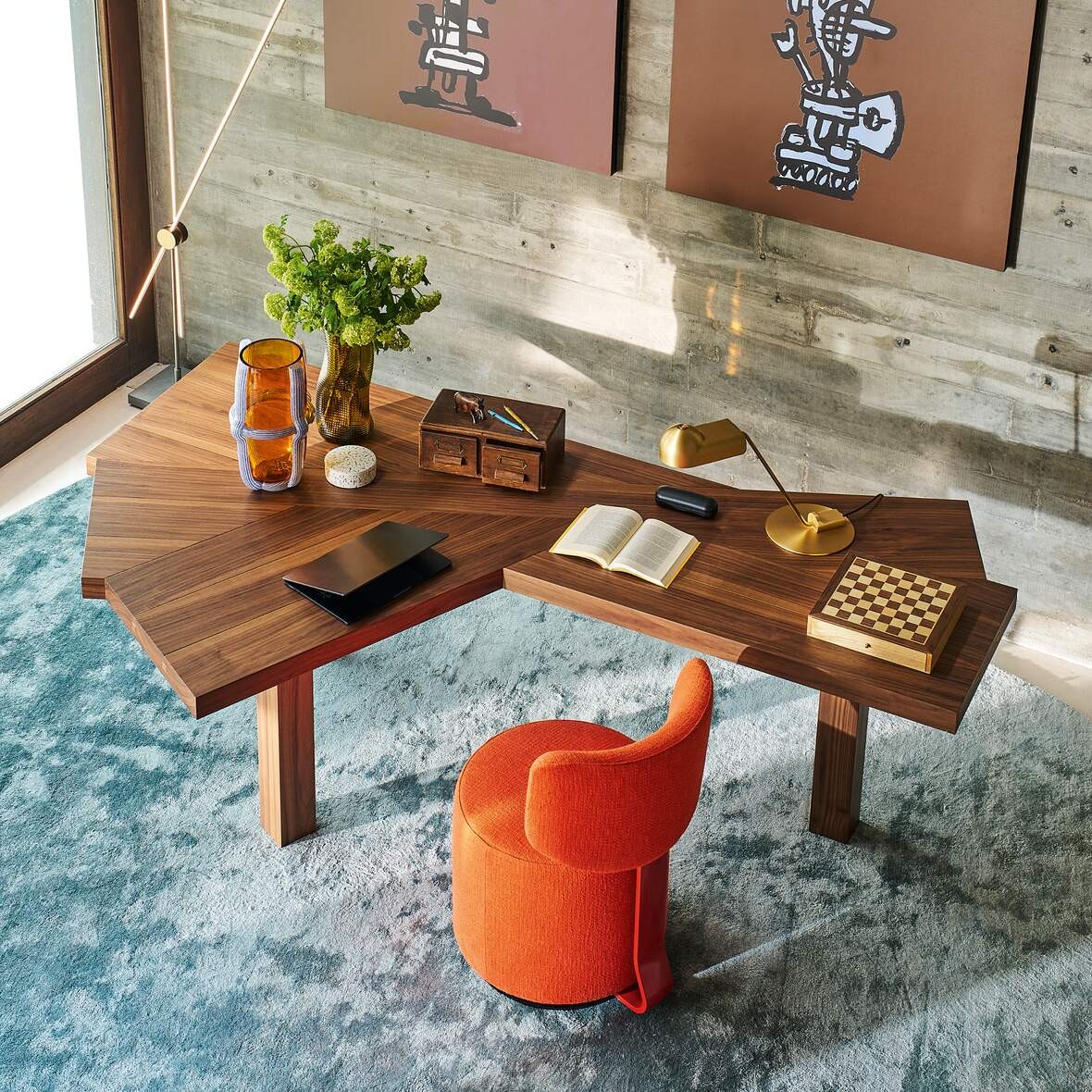
The one she designed for her own house. Charlotte Perriand drew the Ventaglio in 1972 for her chalet in Méribel, in the French Alps, and Cassina now makes it as the 511. Ventaglio is Italian for fan, after the shape of its top, which is made of fourteen oak staves. It is a table first, and Cassina offers it for the dining room, the kitchen or the living room as readily as for work.
That is exactly why I love it as a desk. Perriand spent her working life arguing that furniture should serve the way people actually live, and in a mountain chalet the table where you write letters is also where you eat, play cards and spread out the map. The Ventaglio does not ask you to choose. For a family home where the study has been squeezed out, it is the most honest answer I know: a beautiful table that does not mind being worked at.
Out of Line Homedesk — Bieke Casteleyn
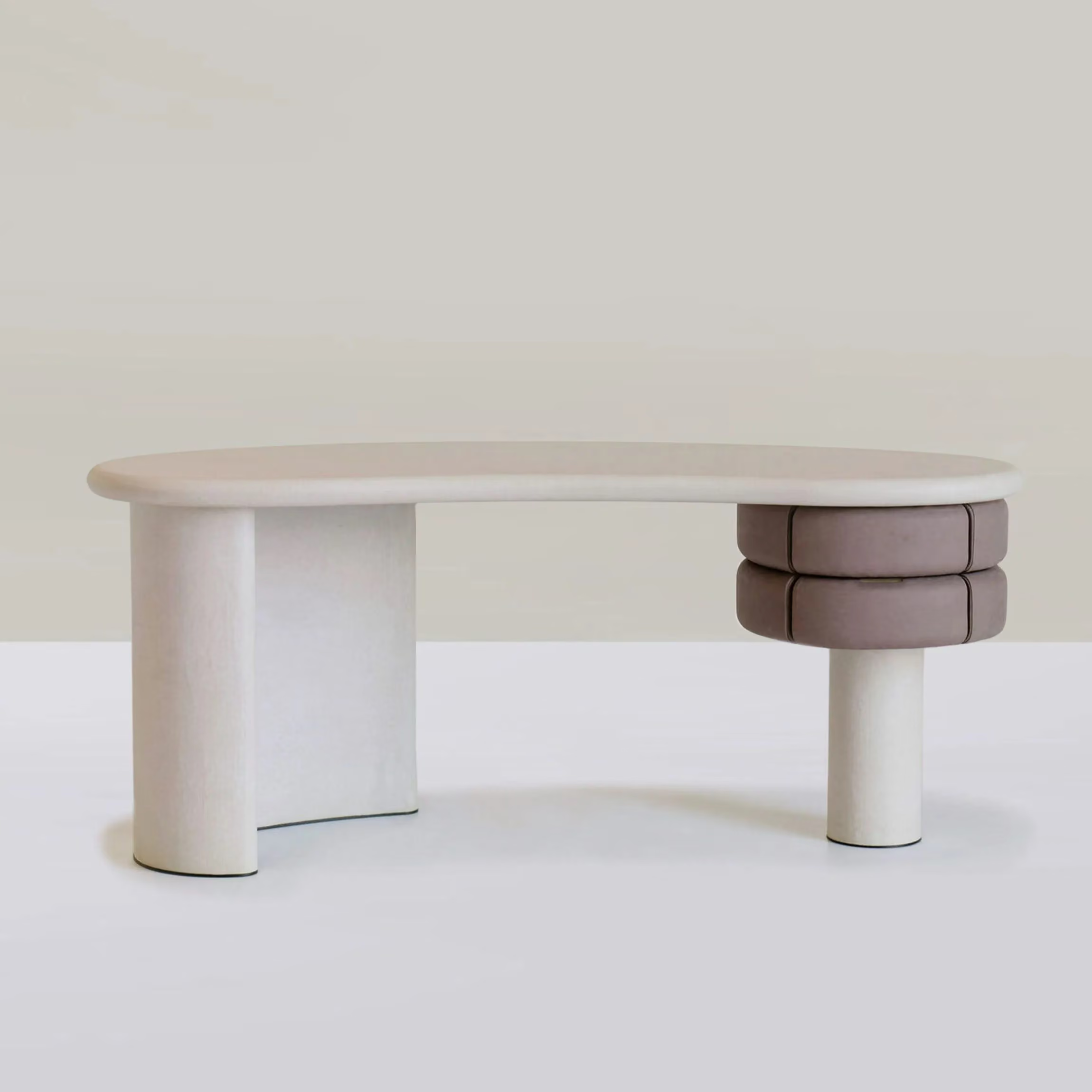
The newest here, and the most sculptural. Bieke Casteleyn studied in Ghent and Milan and set up her studio in Belgium in 2012. Her Out of Line collection followed in 2015, worked largely in cement plaster, and the Homedesk belongs to it: a desk in concrete on a stucco base, with two drawers and a softly curving outline that is never quite straight. Each piece is made by hand to order in Belgium and carries a small label signed by her.
After four desks that try in one way or another to disappear — floating, hovering, standing on two thin legs — here is one that sits squarely on the floor and is glad to be looked at. Concrete is not the material you expect in a home office, and that is what makes it work there. It reads as a piece of sculpture that happens to have drawers, which suits a desk that lives in the sitting room and has to earn its place at the weekend.
What the five have in common
A ship’s captain, a Bond villain, a man who needed somewhere for his ring, a woman writing letters in the mountains, and whoever is lucky enough to keep the Homedesk in their sitting room. On paper the five share very little: walnut and leather, steel and veneer, oak staves, concrete. What they share is that each was drawn for a particular person at a particular kind of work, and that every one of them looks as considered with the laptop closed as with it open.
That is the test I would set any desk now. It will spend more hours being looked at than being used, so it has to be functional sculpture in the plainest sense: an answer to a question of living that still holds the room when nobody is asking it anything. Choose it the way you would choose a dining table, not a printer stand. Think twice, buy once.
Blog title heading will go here