.svg)

Take Five: My favourite Danish brands
Take Five. A series in which I empty my pockets and set out the things I keep going back to - magazines, hotels, books, restaurants, furniture and lighting brands - and try to say honestly why. It is not a ranking, and nothing in it is sponsored. Think of it less as a list of recommendations than as being handed the pile from beside my desk.
Two declarations before we begin. The first: we represent all five of these makers, and you should read what follows knowing it. The order runs the other way round from the one you might suspect - we went looking for them because of how they work, and we have kept working with them for the same reason. The second: I am Swedish, and there is not one Swedish name on the list. I have looked for a way to correct that and decided against it. Denmark settled something in the middle of the last century that the rest of us have been answering ever since.
So this is a line rather than a list. It starts with an architect who could not make furniture, runs through the workshop that could make anything, and ends with two studios still working the same seam today.
House of Finn Juhl
The one who was not a cabinetmaker. Juhl trained as an architect at the Royal Danish Academy, and in a generation where almost everyone came up through the workshop - Wegner, Mogensen, Kjærholm - that made him the outsider. He could not build what he drew. He had to find someone who could, and from 1936 that was the master cabinetmaker Niels Vodder. The distance between those two men is exactly where the work happens. Juhl drew shapes no trained maker would have proposed, because he did not know they were unreasonable, and Vodder found ways to build them.
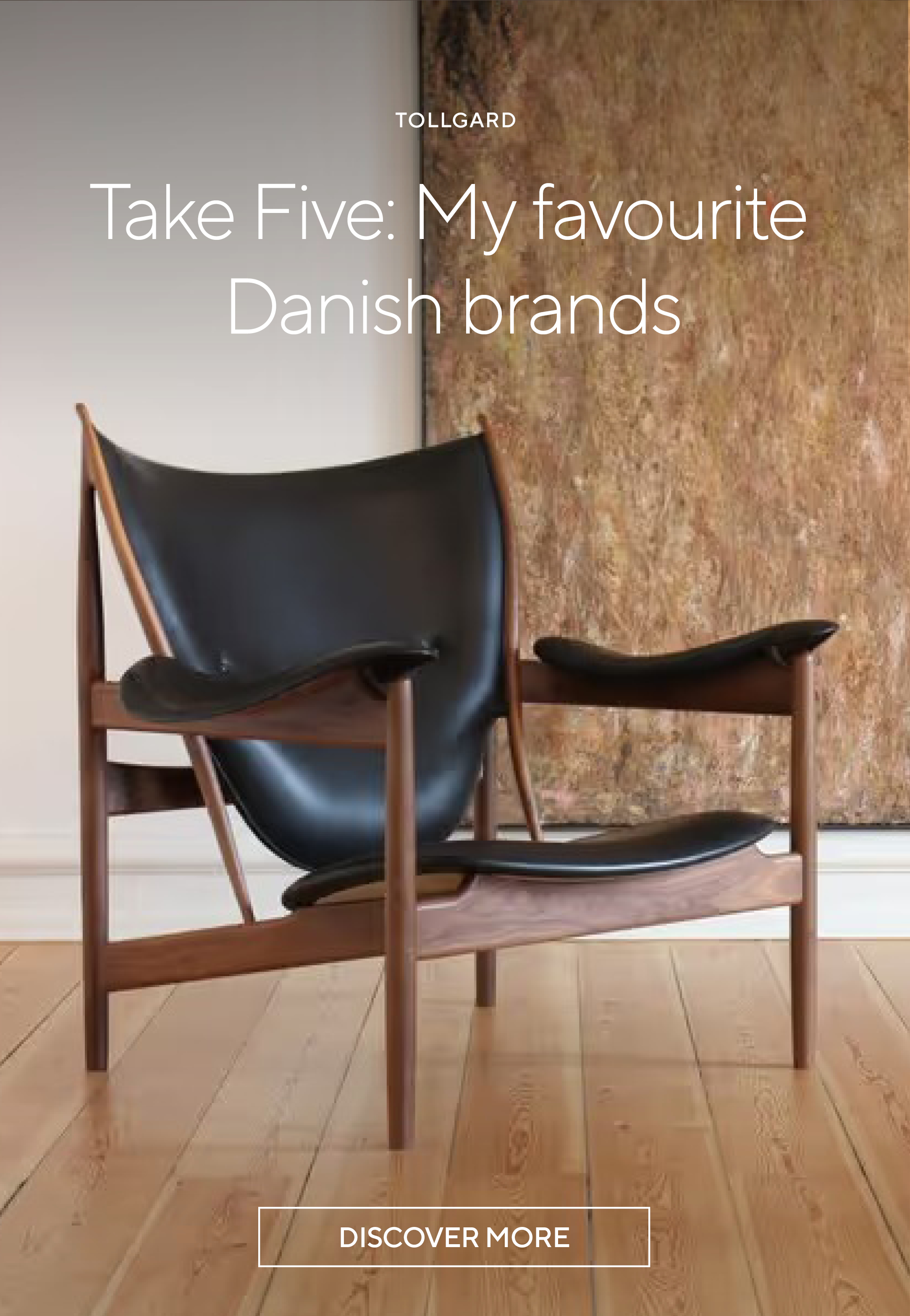
The Chieftain, shown at the Cabinetmakers’ Guild Exhibition in Copenhagen in 1949, is that argument at its clearest. The seat and the back sit clear of the frame rather than inside it, so the leather reads as something laid across the structure rather than packed into it. Juhl was looking at Arp and at Henry Moore, and it shows. No other chair of that decade looks like it, and the reason is that he was drawing rather than making.
Juhl wrote that an architect “should strive for unity but not uniformity, and establish a complete thought process behind everything”. This for me translates into the ‘red thread’ that we weave through our own projects: a unifying design narrative that runs through each project, each piece of furniture that we design, and against which we weigh every decision.

PP Møbler
The workshop that was given the difficult jobs. PP Møbler was founded in Allerød, north of Copenhagen, in 1953 by the brothers Lars Peder and Ejnar Pedersen, and is still run by the family in the third generation. My reading of the Wegner relationship is simple: he sent them the designs that were hardest to make and let the straightforward ones go elsewhere. It began exactly that way. Their first work for Wegner was as a subcontractor to AP Stolen, building the frame of the Papa Bear - the part of the chair nobody else wanted. When the Johannes Hansen workshop failed at the start of the 1990s, PP took on that collection too, the Round Chair among it, rather than watch it disappear.
Which is why the catalogue reads the way it does. It is not a selection of Wegner’s best designs. It is a selection of his most demanding ones, and those turn out to be very nearly the same list.
The Papa Bear is from 1950 and is the friendliest difficult chair ever made. It is put together like upholstered engineering, and then the arms end in two small exposed teak paws. That detail names the chair, but it is there for a reason: a hand needs somewhere to land that is not fabric. Sit in one and you understand why a family keeps it for fifty years and re-covers it twice.

Malte Gormsen
The classicist working now. Malte Gormsen trained as an apprentice cabinetmaker, first with a small family workshop in Scotland and then with Niels Roth Andersen in Denmark, where the job was making Finn Juhl and Vestergaard Jensen pieces to the original drawings. He learned the trade with his hands inside the furniture at the top of this list, which is not a coincidence I can improve on. He set up his own workshop in 1999; it sits in Herlev, outside Copenhagen.
He built the business on interiors rather than on a collection - Noma, Geranium, Geist, 108 - and the collection came afterwards, developed over a decade with Space Copenhagen. The MG106 is a dining armchair in solid oak and paper cord, most of it worked by hand. Paper cord is an honest material to choose, because it cannot be faked and it shows every hour that went into it. What I admire is the restraint. There is nothing in the chair that is there to be noticed.

Vipp
From a bin to a kitchen, and then to a hotel. In 1939 a metalworker in Randers called Holger Nielsen made a pedal bin for his wife Marie’s hairdressing salon. He made three. The name is the sound the lid makes. That bin is now in the collection of the Museum of Modern Art in New York, which is a considerable outcome for a favour done for one’s wife.
His daughter Jette Egelund took the company on in 1992 and moved the object out of the salon and into the home. Her son Kasper runs it now, the third generation. The kitchen followed in the mid-2000s, then the bathroom, then lighting and furniture, and then, with the logic of a company that has never quite believed in categories, a building.
The 453 is Morten Bo Jensen’s swivel dining chair, a polished aluminium frame carrying a leather shell. It is the piece that shows what Vipp actually is. Everyone else in this list began with wood; Vipp began with metal and a mechanism, and eighty-odd years later it still designs like an engineering company that happens to make beautiful things.
Overgaard & Dyrman
The newest name here, and the one I would watch. Jasper Overgaard and Christian Dyrman met as students at Aalborg, went on to the Royal Danish Academy, and founded the studio together in 2013, before they had finished. Christian trained as a blacksmith and Jasper as a leather craftsman, which is the whole company explained in a single line: steel and hide, made by the two people who know those materials best.
The Circle arrived in 2019. Its base is drawn from a drafting compass - a trestle that opens rather than four legs that stand — and the chairs are numbered and made to order. The joinery is cut on modern machinery and finished by hand, and the studio makes no apology for either half of that. Nor should it. The workshops of the 1950s used every tool available to them; the romance about hand tools came later, and mostly from people who were not doing the work.

What the five have in common
An architect, a family workshop, a cabinetmaker, a metal company and two graduates with a forge between them. On the face of it they share very little. What connects them is that in every case the making came first and the style came out of it. None of these pieces is a drawn shape handed to a factory to solve. The Chieftain exists because Vodder could build it. The Papa Bear exists because someone would take on the frame. The Circle looks the way it does because one of the founders can weld and the other can stitch.
That is the Danish lesson, and it is still being taught. Malte Gormsen learned it from a man who made Finn Juhl’s furniture. Overgaard & Dyrman learned it by picking up the tools themselves. Between them, they are carrying on something that began at the Guild exhibitions seventy-five years ago, and they are doing it without nostalgia, which is the only way it works.
Five Danish answers, then, from one Swede who has stopped pretending to be impartial about it.
